
Lynchburg VINELink Release Coverage
Virginia VINE states that it covers every local and regional jail in Virginia. That includes custody events reported for the Lynchburg Adult Detention Center, which the Blue Ridge Regional Jail Authority operates. The service is free and available by web, phone, and mobile app. Anyone may check status without registering. A registration is needed only to receive notices. Events can include release, transfer, escape, or death, while some participating facilities may also report work release or electronic monitoring.
Coverage is tied to the reporting custodian. It is not tied merely to a Lynchburg court case. A person held at a different BRRJA center may have that facility named on the record. Someone in a Virginia prison or on state community supervision belongs in the Virginia Department of Corrections workflow. Federal Bureau of Prisons and ICE custody are outside VINELink. When the legal custodian changes, the correct status source changes too.
The Lynchburg Adult Detention Center is one part of a five-facility regional system. Amherst, Bedford, Campbell, and Halifax adult detention centers are also operated by BRRJA. Research found no fixed public assignment rule for a Lynchburg-connected person. As a result, a missing Lynchburg match may call for a check of the regional custody path rather than a release conclusion. VINE helps identify a reporting facility and event, while BRRJA remains the source for the underlying jail transaction.
Search Lynchburg VINELink Inmate Records
Start with the person's full identity and any booking or offender number already known. A number helps separate people who share a name. The facility name is just as important. For a Lynchburg city booking, look for Lynchburg Adult Detention Center or another BRRJA facility supported by the custody history. Do not assume the Lynchburg facility merely because the arrest or court case arose in the city.
- Open the official Virginia VINELink search and choose the offender or custody search.
- Enter the person's identifying details. Use the booking or offender number when it is available.
- Compare all possible matches by name, identifier, reporting facility, and custody status.
- Open the exact record and note the facility plus the stated custody event before drawing a conclusion.
- If the result says released, check BRRJA, VADOC, or another receiving system for a transfer.
The official interface below shows where a Virginia-specific search begins. View the Virginia VINELink source before relying on saved screen text because the live status can change.
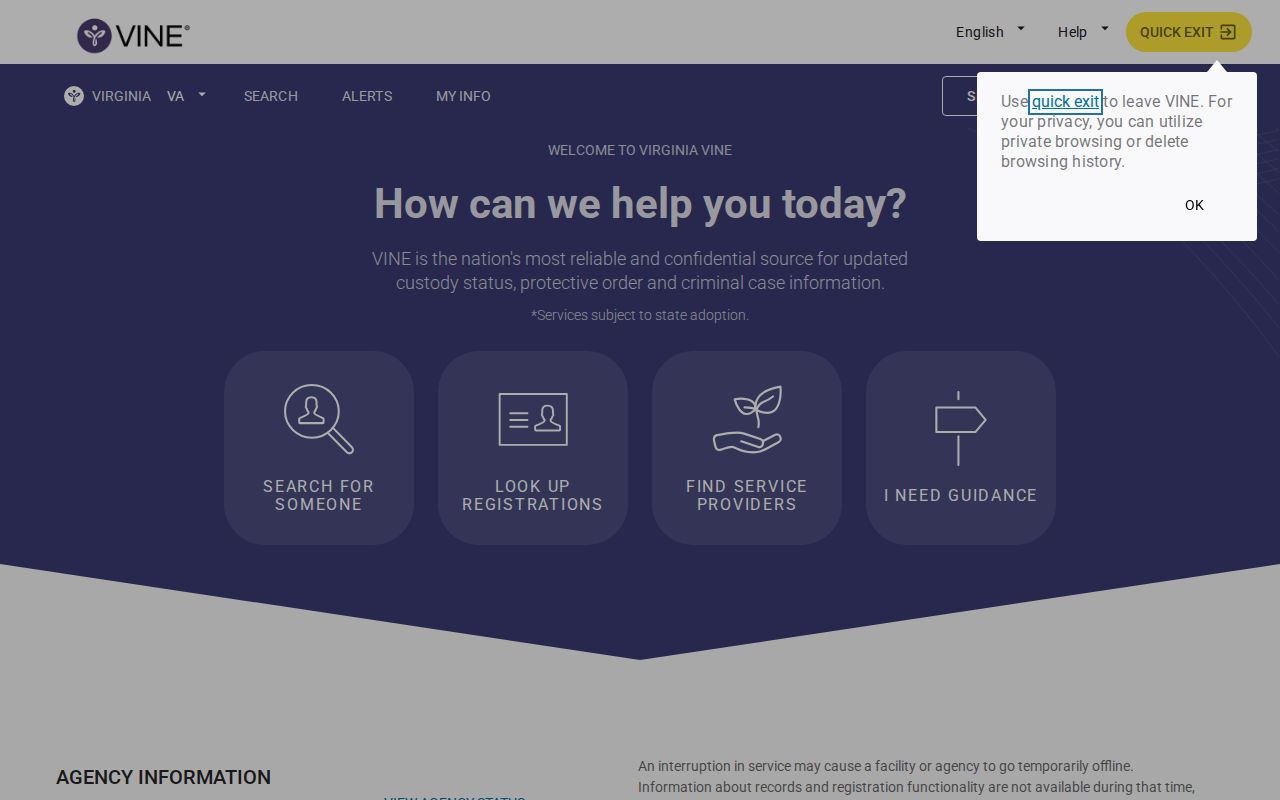
The state landing page establishes the right search jurisdiction, but the opened person record supplies the facility-level event needed for a Lynchburg check.
When no match appears, recheck spelling and the identifier. Then consider whether the person is in state, federal, or immigration custody rather than a participating jail. The full Lynchburg released-inmate search path explains how court and agency records can resolve a missing local result.
A court search can add legal context without replacing the custody record. Lynchburg General District Court handles misdemeanors and felony preliminary proceedings, while Circuit Court handles felony final orders and related appeals. A bond order, dismissal, or time-served sentence may explain why release was authorized. It does not show when BRRJA finished processing, whether a second hold remained, or whether another custodian received the person.
Lynchburg VINELink Release Fields
A VINELink entry is a notification and status record, not a certified release transaction. Read each field in relation to the reporting jail. Exact displays can vary by participant and event, but identity, an available booking or offender number, the reporting facility, and custody status are the core matching points documented for the Virginia workflow.
| Field | What it establishes |
|---|---|
| Name and identity details | Helps distinguish the intended person from a similar name. |
| Booking or offender number | Links the event to a specific custody record when supplied. |
| Reporting facility | Identifies which local or regional jail submitted the status. |
| Custody status or event | Shows the facility-level change, such as release or transfer. |
| Notification options | Shows which phone, email, text, TTY, or app channels can be registered. |
A status marked released does not state the court's final disposition, the exact terms of supervision, or a transfer destination in every case. BRRJA's existing release transaction is the stronger source for the date, time, type, and receiving authority. A court order can explain why departure was authorized. Neither record should be used as a substitute for the other.
Note: Save the booking or offender number because a name-only search can join the wrong Lynchburg custody event to the wrong person.
Register Lynchburg VINELink Release Alerts
Registration attaches selected contact methods to one exact record. It is confidential, and the person in custody is not told who registered. Virginia supports phone, email, text, TTY, and supported app delivery. More than one contact route may be allowed. Telephone notices require special care because the four-digit PIN confirms that the call reached the intended recipient.
- Open the matched person record and choose its registration option.
- Select each supported delivery method needed for that Lynchburg custody event.
- Create and retain the original four-digit PIN for telephone calls.
- Finish the confirmation prompts and verify that all contact details are current.
- When a call arrives, enter the PIN to confirm receipt of the notice.
- For a forgotten PIN, reset, or cancellation, call Virginia VINE at 1-800-467-4943.
If a call is unanswered or not confirmed, VINE may leave a message and keep trying until confirmation or until the documented attempt period ends. That repeat-call process makes the PIN more than a security detail. It closes the notice loop. Contact information should be updated whenever a phone number or email changes.
Register against the exact record, not merely the person's name. If the person later moves into VADOC, the local registration does not automatically follow. Keep any booking number, DOC number, court case number, and alert details together so a later event can be matched across systems. Calling Virginia VINE can resolve a lost PIN or cancellation, but BRRJA or VADOC must answer questions about the custody event itself.
Confirm Lynchburg VINELink Release Events
First identify what the alert actually says. A VINE event can prove that the submitting jail reported a status change. It cannot prove that no other custodian took control. BRRJA operates five adult detention centers, so movement inside the regional system is possible. A state-responsible person may also move into VADOC custody. The court case explains legal authority, while the BRRJA booking and release transaction can identify the administrative departure and destination.
For state custody or supervision, use the VADOC Inmate and Supervisee Locator. It can show a prison, a local jail under VADOC authority, a community corrections placement, or a supervision district. Its information updates daily and may lag. A person who has fully left custody and supervision may require an inactive-record request because the locator is not described as a permanent archive.
- Release event
- The reporting jail says its custody ended.
- Transfer
- One custodian ends control while another begins it.
- Discharge
- The custodial or supervision term ends under the controlling record.
- Detainer
- Another agency asks the current custodian to hold or notify it about the person.
Federal BOP custody is checked through the federal locator, not VINELink. ICE has its own detainee locator. A federal defendant can also be held in contracted local space under U.S. Marshals Service authority. In each case, a Lynchburg connection does not make the matter a Virginia VINE record.
A positive VADOC result also needs careful reading. A correctional facility indicates confinement, while a probation or parole district can indicate community supervision. District 13 serves Lynchburg and nearby localities, but a District 13 connection does not prove the date the person left LADC or a state prison. For completed state release, signed release, parole, probation, or discharge papers carry more weight than a projection or notification alone.
Lynchburg VINE and NAAVI Alerts
Virginia has a distinctive two-system notification layer. VINE covers all local and regional jails and is open to anyone. VADOC now uses NAAVI for eligible post-sentencing victim notifications. Enrollment in a Lynchburg local-jail VINE record does not migrate when a state-responsible person enters VADOC. Qualifying victims must enroll in NAAVI separately, and VADOC reviews eligibility.
The VADOC notification page illustrates the separate state-corrections route.
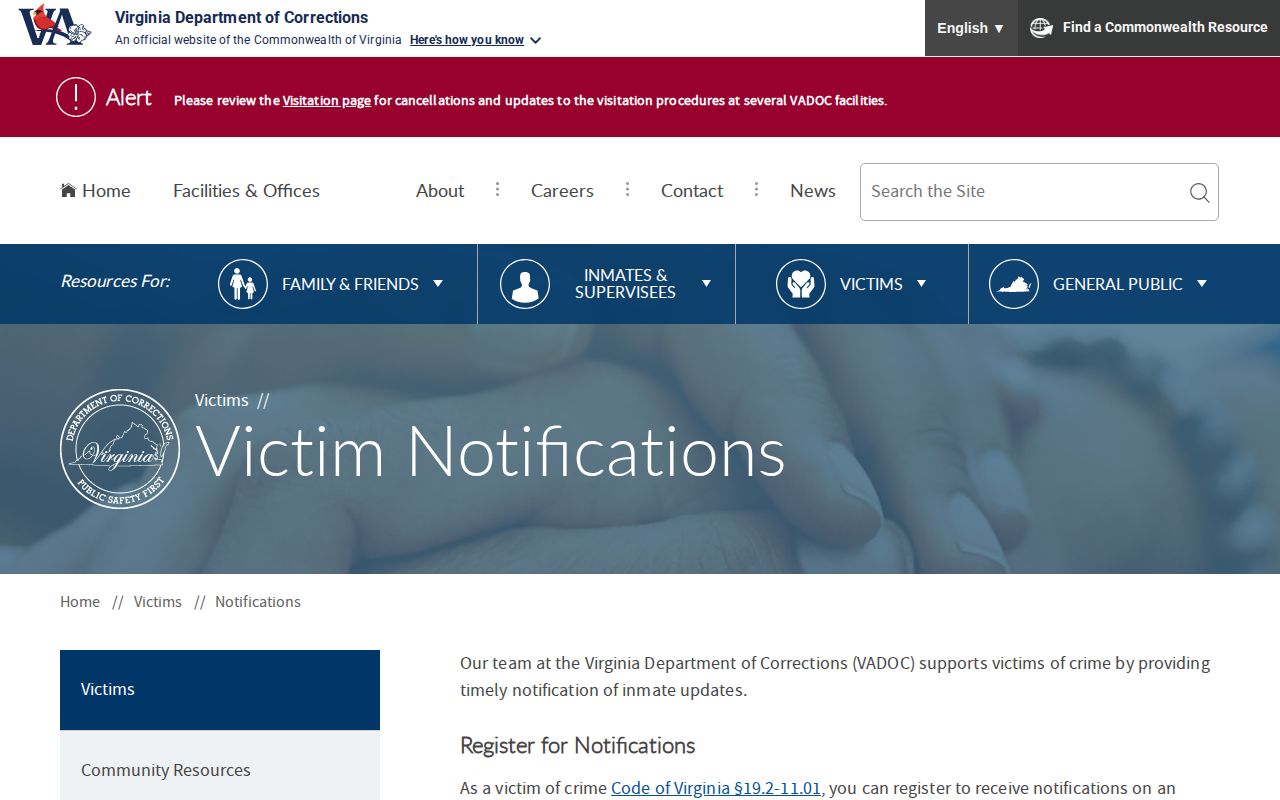
This separation matters most after a transfer. Keep VINE tied to the reporting BRRJA record, use NAAVI only when eligible, and use the public VADOC locator for purpose-neutral custody or supervision verification.
Virginia's three notification and status channels should not be blended. VINE reports local and regional jail events and accepts public registrations. NAAVI is a closed, reviewed enrollment system for qualifying crime victims after a VADOC sentence. The VADOC locator is a public status search for people within current custody or supervision coverage, but it does not send a local VINE alert. If a person leaves LADC for state authority, retain the original VINE event, search the VADOC placement, and use NAAVI only when its victim-eligibility rules are met. If the VADOC locator later points to Lynchburg District 13, that can support a community-supervision connection. It still does not supply the LADC exit minute. The BRRJA release transaction remains the best source for when and how local custody ended, while signed VADOC papers establish the later state release or supervision terms.
Note: A local VINE registration and a VADOC NAAVI enrollment are separate even when both relate to the same Lynchburg case.
Keep each notice with its timestamp and named source. That small record helps distinguish a new event from an old alert repeated by message or email.