
ICE Detainee Release Destinations
ICE administers federal civil immigration custody. It is separate from BRRJA, VADOC, BOP, and the U.S. Marshals Service. A person leaving ICE custody may enter the community under immigration conditions, move to another legal custodian, or have a court or agency process that continues outside detention. A public ICE release lead does not explain every later obligation.
No ICE detention facility appears in the official Lynchburg directory. A Lynchburg-connected person may first be held at LADC or another BRRJA center, then be picked up under an immigration detainer. In that sequence, the BRRJA release record proves the end of local custody. The ICE record establishes the next federal civil custody phase.
Search an ICE Release Record
The Online Detainee Locator System, or ODLS, offers two search routes. The strongest uses the nine-digit A-number and country of birth. Add leading zeroes when an A-number has fewer than nine digits. The identity route uses exact name and country of birth, with date of birth available as an optional narrowing field.
- Choose the A-number route when the immigration identifier is known.
- Enter all nine digits and the country of birth.
- Otherwise enter the exact name and country of birth, adding date of birth if available.
- Compare the result with the BRRJA release destination and immigration case information.
- If no match appears, retry exact spelling and use ICE's information line or records process.
Minors are excluded from the public search. Adult-release instructions must not be applied to a child or used to infer a confidential record. Exact-match rules, timing, and safety or security exclusions can also prevent a public result.
| ODLS field | Use |
|---|---|
| A-number | Nine-digit immigration identifier; add leading zeroes if needed. |
| Country of birth | Required with either search route. |
| Exact name | Identity route when no A-number is known. |
| Date of birth | Optional field that can narrow the name search. |
ICE Recent Release Scope
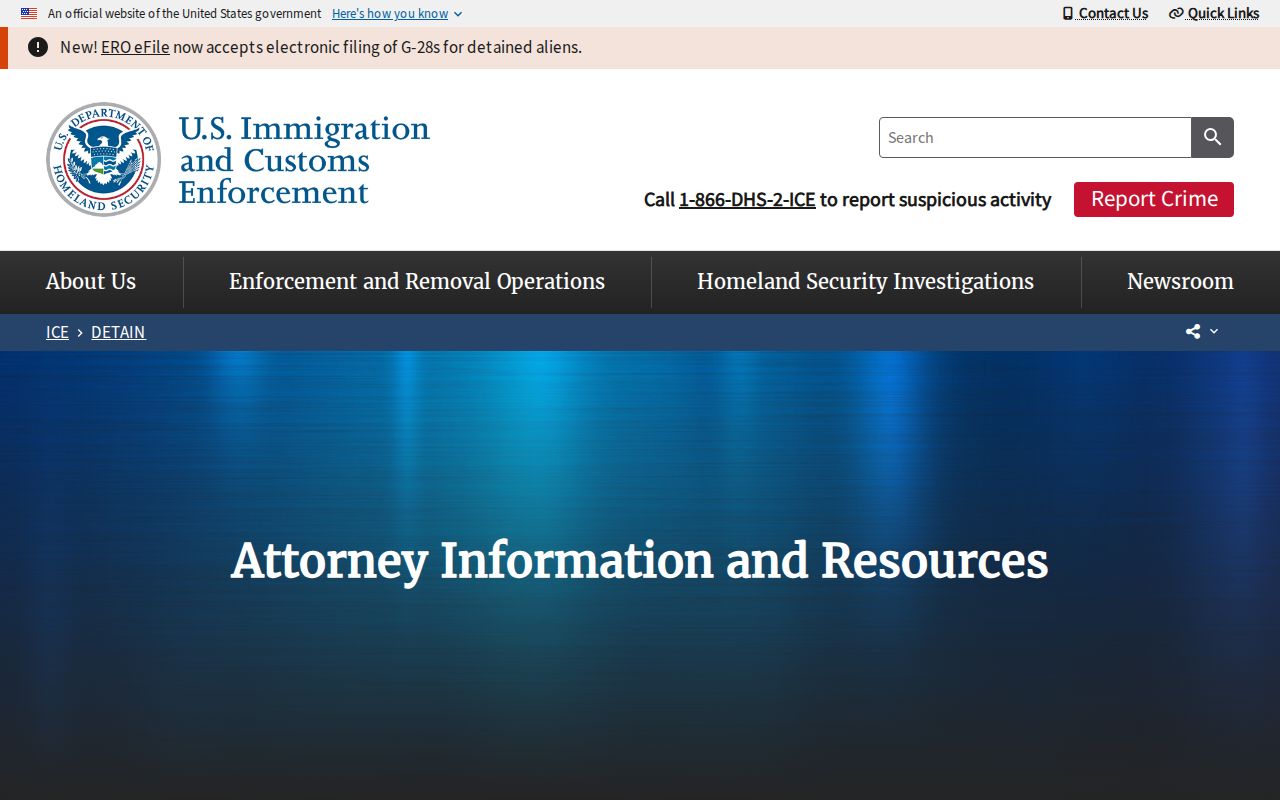
An official ICE attorney-information resource says ODLS includes current detainees and people released from ICE custody within the last 60 days. It is not a permanent archive. A no-result finding can reflect an older release, exact-name mismatch, excluded record, missing leading zero, or other system limit. It does not prove the person was never detained or released.
The ICE scope statement documents the recent-release window.
The federal source supports a carefully limited recent-release statement, not a claim of complete historical coverage.
For an older or unresolved event, preserve the A-number, exact name, country of birth, relevant dates, and the local release destination. ICE FOIA and immigration-court records may provide the durable path when ODLS coverage has expired.
ICE Detainee Information Contact
The ICE Detainee Reporting and Information Line, known as DRIL, is the documented phone fallback. It provides language assistance and can help when the online search does not resolve current or recent custody. Person-specific details may still be limited by law and identity requirements.
1-888-351-4024
Monday through Friday, excluding holidays
8 a.m. to 8 p.m. Eastern
Language assistance available
Have the A-number, full name, country of birth, date of birth, and last known detention information ready. Explain whether the question concerns current ICE custody, a recent ICE release, or a transfer from BRRJA. Those are different events.
Note: DRIL can help route a custody question, but the underlying record controls the verified release date and disposition.
ICE Detainers After Lynchburg Release
An immigration detainer asks a jail to notify ICE before a person would otherwise be released. ICE also describes a request to maintain custody for up to 48 hours beyond that release point so federal officers can assume custody. The detainer does not itself turn BRRJA into an ICE facility, and it does not establish a later ICE release.
Ask BRRJA for the date, time, type, and destination of the LADC custody-ending transaction. If the destination identifies ICE, search ODLS next. Keep the local and immigration dates separate. One marks the end of BRRJA custody; the other may mark later departure from ICE.
A detainer can also explain why a court order and community arrival do not occur at the same time. The local charge may be resolved while federal civil detention begins. The Lynchburg release record process provides the local records route without confusing it with ICE status.
No Lynchburg ICE Facility
Official directories list no ICE detention facility in Lynchburg. Geography must not replace legal custody. A person can be arrested in the city, held at a BRRJA center, and later appear in ICE without any immigration facility being located nearby. The receiving facility may be elsewhere.
BRRJA is itself regional. Its five adult centers include Lynchburg, Amherst, Bedford, Campbell, and Halifax. A disappearance from the Lynchburg search can therefore be an internal BRRJA move even before ICE is considered. Confirm the release destination rather than assuming the federal transfer from a missing roster result.
- Local release
- The regional jail ends its custody.
- ICE pickup
- Federal civil immigration custody begins.
- ICE release
- The person later leaves ICE custody.
- No ODLS result
- An inconclusive search outcome, not proof of no history.
Verify ICE Release Records
Use a chain of records. First, the BRRJA transaction identifies the local departure and receiving authority. Second, ODLS supplies a current or recent immigration-custody lead. Third, ICE or immigration-court records provide older or more detailed proof. The documents answer different questions and can carry different dates without contradiction.
Do not substitute a BOP search for ICE. BOP covers federal criminal imprisonment, while ICE covers civil immigration detention. USMS custody is another separate federal phase. A Lynchburg federal or local case can involve more than one of these systems.
When making a records request, ask for existing records tied to the A-number, exact identity, date range, and known detention event. A narrow request is more likely to locate the relevant custody or release record than a broad request for every fact about the person.
Lynchburg ICE No-Result Checks
A no-result ODLS search is inconclusive. First verify the A-number has nine digits, including any needed leading zeroes, and pair it with the correct country of birth. For a name search, use the exact name rather than a nickname and confirm the country of birth. Date of birth can narrow the search, but it does not cure a different spelling or a record outside the public window.
Next consider timing. The official recent-release statement covers people released from ICE custody within 60 days, not every historical release. A Lynchburg local release date is not the start of that window if ICE custody began afterward. Use the date ICE released the person, when known. Older cases can require ICE FOIA and immigration-court material.
Safety, security, and system exclusions also limit results. Minors are not publicly searchable. Do not translate a protected or excluded record into a finding that detention never occurred. DRIL can help route an adult custody question, but it may not disclose every fact.
Preserve the search date and exact fields used. If a later result differs, the record may have updated, aged beyond the recent-release window, or changed custody status. A dated search note prevents an old screenshot from being presented as current ICE status.
ICE Release Versus Case Status
Leaving ICE detention does not necessarily end immigration proceedings. ODLS addresses detention status, while immigration-court records address the legal case. Conditions may also apply after physical release. Keep the custody event and court process separate, just as a Lynchburg criminal court order and BRRJA exit record answer different questions.
If BOP or USMS custody preceded ICE, retain those identifiers too. A BOP register number does not replace an A-number, and a federal criminal release date does not prove the later immigration release date. The clean record chain shows each custodian, the date its control ended, and the supported next destination.
A Virginia court record may explain why local criminal custody ended, but it does not control the immigration case. Likewise, an ICE release lead does not revise the Lynchburg charge disposition. Ask each office for the record it actually maintains. This division keeps the BRRJA date, immigration detention period, and any later court action accurate even when the same person appears in all systems.
Keep copies of official responses and note the search date. That evidence helps explain why a later ODLS search may no longer display an older release.