
Lynchburg Projected Versus Actual Release
Virginia uses the exact label Projected Release Date. The word projected must remain attached to the date because it describes an administrative calculation at one point in time. Sentence structure, earned credits, court orders, disciplinary events, and other custody matters can change it. The actual release is a completed event supported by a signed release document or the custodian's release transaction.
A pretrial detainee at Lynchburg Adult Detention Center has no calculated sentence-ending date. Bond, recognizance, dismissal, time served, a new order, or another hold may determine whether that person leaves. Even when a judge authorizes release, BRRJA must process the order and check other custody claims. For a sentenced state prisoner, VADOC calculates the projected date. Local authorities may calculate a local sentence.
That difference also separates legal authority from physical movement. A court order can explain why release is permitted. A jail or prison record shows when custody actually ended and whether another agency received the person.
The record type should match the question. A VADOC Projected Release Date answers what the state calculation currently anticipates. An Order of Release, Conditions of Parole, or Conditions of Probation can document the terms applied when state custody changes. A BRRJA release transaction answers when LADC stopped holding the person and can identify a transfer or receiving authority. A Lynchburg court order supplies the legal result, such as bond, time served, or a sentence, but it may precede jail processing. No one field can safely stand in for all four. When dates differ, compare the DOC number or booking number, the court case, the named custodian, and the document's purpose before deciding that one source is wrong. Processing lag and a later order can create a valid change without erasing the earlier projection.
Find a Lynchburg Projected Date
Choose the search route by custodian, not by the city where the case began. No VADOC prison is located in Lynchburg. A person sentenced on a Lynchburg matter may remain in a regional jail under VADOC authority, move to a prison elsewhere in Virginia, or later appear at a community-supervision office. A BRRJA detainee and a state prisoner therefore require different records.
- Confirm whether the person is pretrial, serving local time, or serving a state-responsible sentence.
- For state responsibility, open the VADOC Inmate and Supervisee Locator.
- Search by the seven-digit DOC ID, or use the first three letters of the first name and complete last name.
- Open the exact match and read the location, custody status, and Projected Release Date together.
- For an LADC local sentence or pretrial matter, ask BRRJA and the correct Lynchburg court for the controlling record.
- After departure, obtain the release transaction or signed Order of Release instead of repeating an old projection.
The official public layout in the manifest displays the exact field label. Review the VADOC public record layout only as evidence of the interface, not as an example of a Lynchburg person.
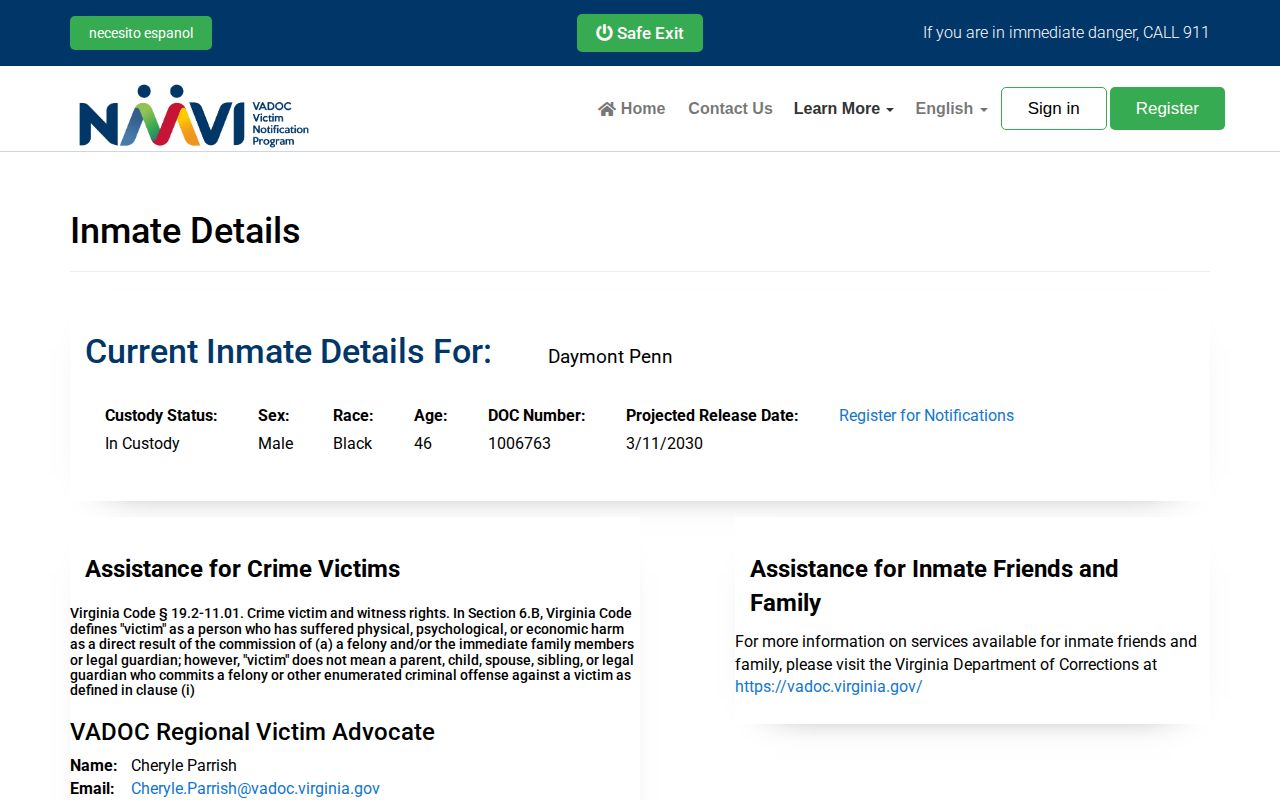
The image confirms the date's projected label. It does not establish actual release or a Lynchburg connection for the record pictured.
VADOC warns that locator data update daily and can be inaccurate or outdated. Match the DOC number and placement before relying on the date. The broader Lynchburg release records process explains how BRRJA and court records fill the local gap.
Lynchburg Release Credit Regimes
Virginia time computation begins with the controlling sentence and the amount of active time. VADOC also considers qualifying jail time before state receipt, sentence type, credit class, disciplinary offenses, and later calculation events. Concurrent terms run together to the extent ordered, while consecutive terms run one after another. Corrected orders, uncalculated sentences, mandatory minimums, detainers, and multiple cases can defeat a simple calendar estimate.
Older Good Conduct Allowance rules in Virginia Code § 53.1-201 generally apply to older offense-date categories. The statute describes four classes: 30, 20, 10, or zero days earned for each 30 days served. Those rates should not be applied to a modern felony just because they produce an appealing date.
For felony offenses on or after the governing 1995 threshold, § 53.1-202.3 sets earned sentence credit rates. Enumerated serious offense categories may earn no more than 4.5 credits per 30 days served. Other eligible offenses use Level I at 15 days, Level II at 7.5, Level III at 3.5, and Level IV at zero. Participation, cooperation, assigned work, education, and discipline can affect classification. Reviews can change the earning pace.
Qualifying pretrial confinement credit is governed by § 53.1-187. Time on bail does not count under that provision. Earned credits also do not reduce the term required before parole eligibility. Each date must therefore be traced to the correct offense date, statute, and sentence record.
Why Lynchburg Release Dates Change
A projected date can move forward or backward as the legal and administrative record changes. The public date is the output, not the whole calculation. VADOC Operating Procedure 050.3 requires review of warrants, detainers, continued-custody orders, sentence calculations, and other matters before state release.
| Factor | Possible effect on the date |
|---|---|
| Credit level or review | A new earning rate changes how fast eligible time is deducted. |
| Discipline or forfeiture | Loss of credits can move the projection later. |
| Pretrial credit | Verified qualifying confinement can change time already credited. |
| New or corrected order | The controlling sentence, active time, or term structure may change. |
| Concurrent or consecutive terms | The way multiple sentences combine affects the end point. |
| Warrant, detainer, or hold | The date may arrive without community release because another custody claim remains. |
| Parole action | A decision can begin planning, but it does not itself set physical release. |
A parole grant is a good example. The Virginia Parole Board makes the decision for an eligible case, while VADOC completes records checks and sets the release process. A grant date, hearing date, or vote date should never be substituted for the actual release date.
Note: A detainer may prevent community entry even when the original Lynchburg sentence reaches its projected end.
Confirm a Lynchburg Release Date
For a completed VADOC release, seek the signed Order of Release or the applicable parole, probation, or discharge papers. The state facility-release process includes final record review and signed documents. VADOC says discharge or parole release from a state facility occurs by 11:59 p.m. on the release date, weather permitting. That is a state-facility rule. It must not be presented as an LADC release schedule.
For Lynchburg Adult Detention Center, ask BRRJA for the existing booking and release transaction. Useful fields include the exact date and time, release type, and destination or receiving authority. A court final order helps explain bond, dismissal, time served, or sentence terms, but the court summary does not prove the jail's administrative exit time.
Address the request to the authority that holds the record. BRRJA operates LADC, so its records channel is the starting point for a Lynchburg jail transaction. If the issue is the calculation in a state-responsible sentence, VADOC is the right office. A local court clerk can supply the final or sentencing order, but the clerk does not calculate every prison credit or certify the minute a correctional facility released someone.
A VINELink release check can provide a pending custody-change notice for a BRRJA record. Treat it as notification evidence. If the alert may reflect a transfer, check other BRRJA centers, VADOC, or the supported federal or ICE source before calling it community release.
- Projected release
- The present administrative estimate.
- Actual release
- The completed custody-ending transaction.
- Parole
- Conditional service of an eligible sentence in the community.
- Discharge
- The end documented by the controlling custody or supervision record.
Calculate Lynchburg Release Dates Carefully
The familiar statement that many people under Virginia truth-in-sentencing rules serve at least 85 percent is not a personal calculator. Section 53.1-165.1 generally abolished discretionary parole for felonies committed on or after the 1995 threshold, subject to exceptions. Current earned-credit rates still vary by offense category and earning level. Older offenses can fall under a different regime.
The VADOC time-computation page is the official starting point for these factors.
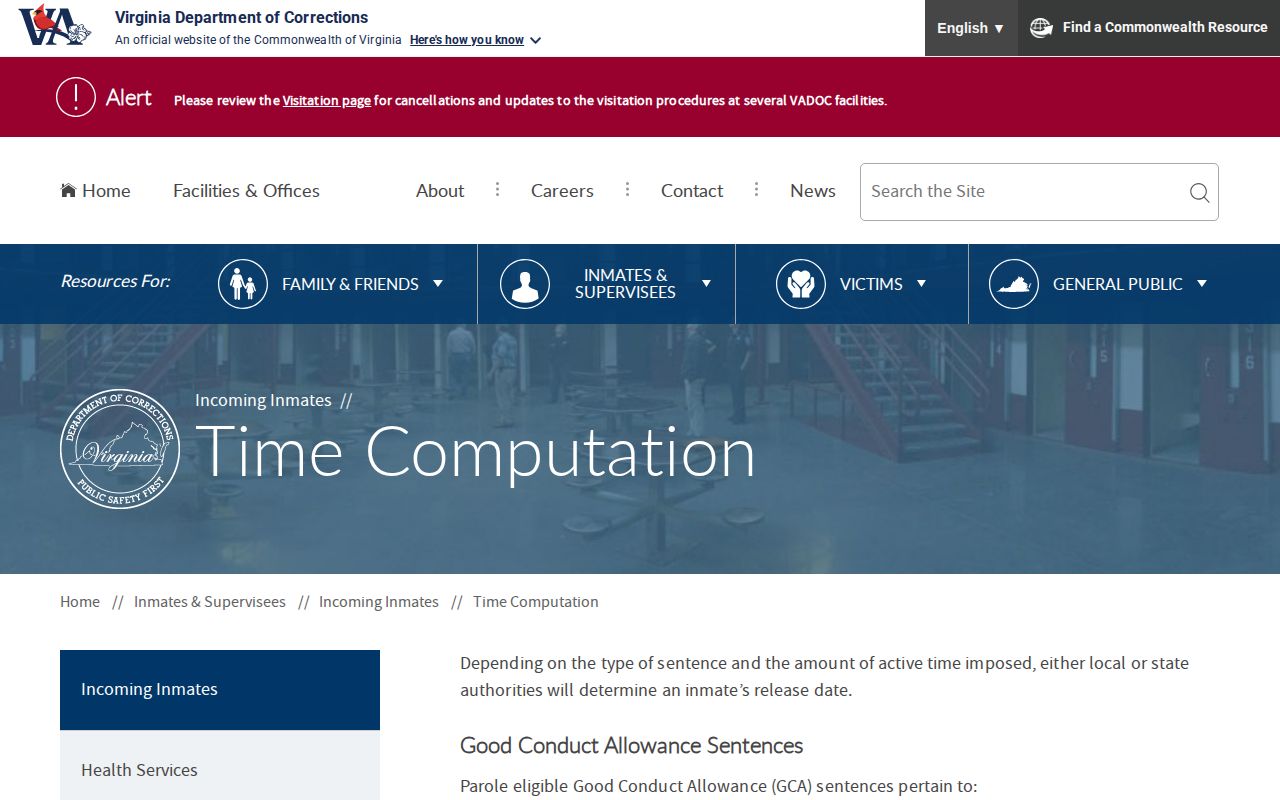
The state explanation reinforces why offense dates, sentence structure, credits, discipline, and court changes must be reconciled rather than reduced to one percentage.
Mixed offenses make the risk greater. One term may be subject to a limit or exclusion that does not apply to another. An annual or immediate classification review can also change credit earning. VADOC's actual computation controls the displayed projection.
Parole eligibility adds another layer for qualifying cases. The Virginia Parole Board decides whether parole is granted, but VADOC sets the physical release process after required notice and checks. Earned sentence credits do not shorten the period that must pass before parole eligibility. This is why a parole report, a projected date, and an Order of Release may carry three different dates without contradicting one another.
Lynchburg Inactive Release Records
A fully discharged person may fall outside the VADOC locator's stated coverage of current custody and supervision. Virginia provides a specifically named Form 17, Request for Inactive Inmate or CCAP Probationer/Parolee Records. Form 14 covers consent where required. These routes are more accurate than concluding that no state history exists when the public locator returns no match.
VADOC correctional and supervision records have exemptions, so a general FOIA request may not yield the whole file. Ask for the precise release or discharge document and follow the access and consent instructions on the VADOC operating-procedures page. For an LADC record, use BRRJA instead. The agency that held the person is the proper first custodian.
A no-result finding must be described narrowly. It can mean that custody and supervision ended, that the name or identifier was entered incorrectly, or that the public locator's scope does not include the historical record sought. Preserve known case, booking, and DOC identifiers. They make an inactive-record request more precise and reduce the chance of joining a Lynchburg sentence to the wrong person.
Note: A missing public locator profile after full discharge does not erase the signed Lynchburg or VADOC release record.
Requesting the exact document also avoids asking an agency to create a new calculation or narrative that it does not already maintain.